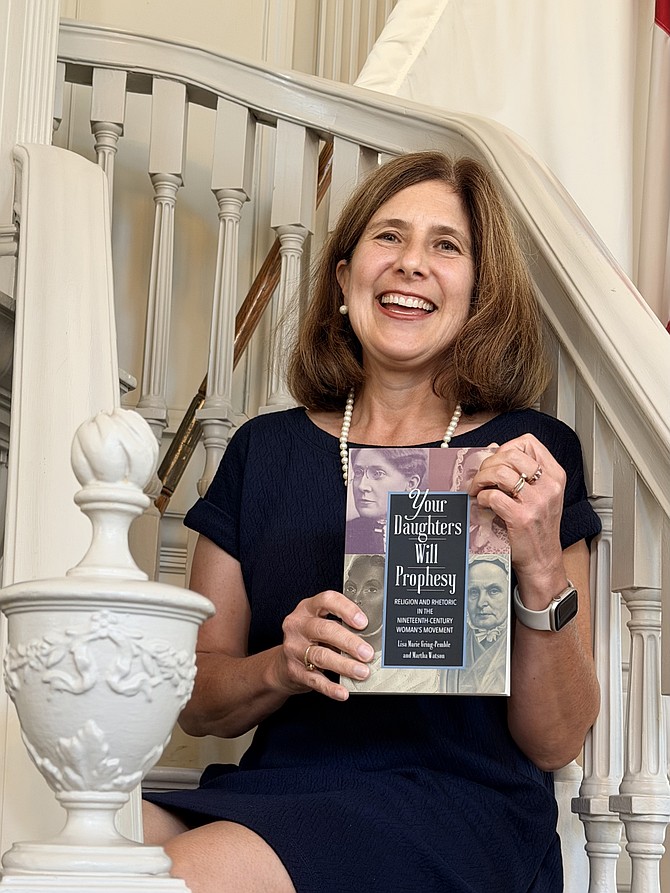
Author Lisa Marie Gring-Pemble holds the book she authored with college and friend Martha Watson.
This August, on the 106th anniversary of the official certification of women’s right to vote in the United States, we note that, in today’s world, women’s rights and words, still, are often questioned. Modern American women themselves often forget just how recently come-by are the rights that we consider basic. Such as the right to vote, to be protected from domestic violence, to hold a personal bank account, to receive credit without a husband’s permission, and to serve on a jury. Relatively recent too, and often challenged, is the right for women to make personal reproductive choices; and even social acceptance of women’s conduct and dress, including speaking, holding office; and wearing pants in public.
A recent book, by local authors Lisa Marie Gring-Pemble and Martha Watson, takes us back to the time before passage of the 19th amendment, when women had fewer rights than we enjoy today. The authors note the dilemma of 19th century women who felt called to improve society “caught between their identity as Christians and social norms that silenced them.” The book tells how they argued against the challenges of expected subserviency by women of their day.
Gring-Pemble relates that women were expected to be silent in public. That society in 19th century America recognized two spheres: public, which belonged to men; and private, which belonged to women. “The Cult of True Womanhood” defined the core virtues for women as: piety, purity, submissiveness and domesticity. The authors’ book describes how four particular women used the agency of accepted scripture to argue for change and to claim their voice on the moral questions of the day. For its title, “Your Daughters Will Prophesy,” the book borrows directly from a specific Biblical text: Joel 2:28, to argue for women’s right to speak in public. The authors relate how several women used that, and other scripture, to turn passages derived from the Bible, previously used to create social norms repressing women into arguments to favor their cause. Joel 2:28: “And afterward, I will pour out my Spirit on all people.Your sons and daughters will prophesy, your old men will dream dreams, your young men will see visions.”
The Gring-Pemble/Mason book analyzes the rhetorical resources of four American women of the time: Jarena Lee, Sarah Moore Grimke, Lucretia Coffin Mott and Frances Willard; who used scripture to “claim moral and then rhetorical agency;” their right to be heard.
Author Lisa Marie Gring-Pemble has been a professor at George Mason University for 26 years, where she teaches courses on professional skills, business and communication. She also developed and teaches a course on the early women’s movement during the 19th century at Mason. Her co-author, Martha Watson, formerly of the University of Maryland, was her dissertation adviser, now friend. It was Watson who suggested the two write the book together. Watson is now retired from teaching and serves as an Episcopal priest.
Borrowing on its historic atmosphere to help envision women’s call to public speaking entangled with religion, we sat down with Gring-Pemble in the pews of the historic Pohick Episcopal Church. The Lorton church, called George Washington’s church, has held services since 1774. Following is an edited summary of questions and answers.
Q - What led you to examine women’s history in the 1800’s?
A- The author notes the era was a subject of her study “before the book adventure”. And she has had an on-going interest “in the way people use language to transform their communities, and the realities of where they live.” She describes being “captivated when imagining a time when women could not speak in public and could not advocate at all. How did they find each other and start the women’s movement?” She points to the opportunity provided by the Second Great Awakening in the early 1800s. “It was a time when abolitionism, temperance and women’s rights were sweeping the country, along with growing church membership. In the competition to safe souls, anyone could preach, even women.”
Q- Why was it the Bible the women turned to for agency?
A- Gring-Pemble describes that the Bible was well known and readily available at the time, thanks to Martin Luther and the printing press. Many knew the biblical verses, stories, and characters. “The Bible had authority, so women could use its words to challenge and enlarge women’s role. They could take passages that people knew but were overlooked when considering women’s roles. Like Mary Magdalene, who was the first to find the resurrection of Jesus at the tomb. They reinterpreted that story to suggest Mary Magdalene was obviously a preacher, as the first to proclaim the risen Lord. They also reclaimed passages that were overlooked, such as God taking the rib from Adam to form Eve, as a helpmate. They suggested that God had created Adam and Eve in his own image; creating male and female, which seemed to put them on an equal playing field.”
“They also found passages that white men leave out, that suggested that God’s wishes should be honored in how to work with women. They found examples of women all over the globe with positions of authority; and those in the Bible in authority.” Such as Deborah, a prophet, judge and spiritual leader, who led Israel back to God. “Deborah was a major war player, and she and others document scores of Biblical women, and show what women can do that men have ignored .”
The book highlights four women:
* Jerena Lee, born a free black woman, who taught herself to write; was the first female preacher in the African Methodist Episcopal Church (AME), and was the first African American woman to publish an autobiography. She faced hostility while preaching and AME ultimately ruled that women could not preach in 1872. Earlier she preached in the slave state of Maryland, saying, as Gring-Pemble relates, “She can be called to preach because the Bible says “daughters will prophesy.” She ignited a conversation in Methodism and her spiritual journey book became that first published autobiography.”
* Frances Willard, a college educated teacher, who was a founder of the Women’s Christian Temperance Union, and later became its president until her death. Gring-Pemble describes her as “seen as less caustic than suffrage leaders Susan B. Anthony and Elizabeth Stanton, and regarded as greater and better known than Queen Victoria [at the time]. She tempered her argument for more women’s rights by emphasizing ‘home protection’ rather than for suffrage.”
* Sarah Grimke, born to a wealthy South Carolina planter family, she moved to Pennsylvania, became a Quaker, and spoke on the abolitionist lecture circuit; becoming an outspoken advocate for education and suffrage for African American women. It was acceptable for women to write letters. Gring-Pemble says “Grimke wrote her Letters on the Equality of the Sexes, and the Condition of Woman to a friend, knowing the letters would be published. The Governor of South Carolina later exiled her from the state because of the letters.
* Lucretia Coffin Mott, a participant in the Seneca Falls Convention, a Quaker preacher; she helped found the Female Medical College of Pennsylvania, the first female medical school, and Swarthmore College, the earliest coed college. Gring-Pemble describes her as “well liked, better known, and as a Quaker, used to speaking.” She responded to the prominent Massachusetts lawyer and politician and author Richard Henry Dana, who opined on proper restricted roles for women. “Mott responds without being aggressive, complements his discourse on women, and admonishes him for having the wrong impression of God.”
Q - Why did these particular four women stand out to you as representatives of their era, among all the women activists of their day?
A - “They were chosen for the things they wrote; being so influential and in getting so many other women into the women’s movement. … Lee published her spiritual journey autobiography; Willard wrote extensively on women’s rights and social reform; Gimke authored the 15 ‘Letters on Equality’ … published serially in a newspaper; and Mott’s letters were published as “Discourse on Women.”
Q - With women’s rights still under attack today, do you think history holds strategies that could be effective in helping women’s voices be better heard now?
A- Gring-Pemble suggests there are three lessons to take from the 19th century for use by women today. “Honor the complexity of the women’s movement. Not all will share all the same circumstances and experiences. The second lesson surrounds the idea of civil discourse. The women then were passionate, biting, riveting, but with different and competing arguments. With discourse and truly understanding where others came from, they were able to find shared goals. And third, with perseverance, determination and grit they fought for issues they would never realize themselves. They never had the opportunity to exercise the right to vote, but they worked for the rights of others. We are still debating many of the same issues, but we can have great hope in women for their fortitude. Because of what they did, ‘our daughters can prophesy.’”
The Gring-Pemble/Mason book was published in 2025 by the University of South Carolina press, and is available in hard/soft copy and Kindle on Amazon.
Votes for Women
This year marks the 106th anniversary of the official certification of the 19th Amendment, for Women’s Suffrage Rights.
On Aug. 18, 1920, Tennessee became the 36th state to ratify the amendment; providing the required majority of the then-48 states. Virginia’s General Assembly had voted against ratification in February 1920. It was one of twelve, mostly southern states to do so. However, in February 1952, Virginia symbolically ratified the amendment, after it was law.
The amendment, introduced in 1878, took 42 years to become law. It was officially certified on August 26, 1920. It contained the simple text: The right of citizens of the United States to vote shall not be denied or abridged by the United States or by any States on account of sex. Congress shall have power to enforce this article by appropriate legislation.